

Authentic Balkan Villages – You step into a Balkan village. Stone lanes echo with footsteps. The air smells of woodsmoke and simmering peppers.
Elderly men nurse tiny coffees under linden trees. A woman waves you over. She offers still-warm bread from her courtyard oven.
Nothing here feels staged. Life moves at its own pace. You’re a quiet guest invited to observe.
Suddenly, someone presses a glass of rakija into your hand. The moment feels warm and welcoming. You smile, ready for more.
What to Expect From Authentic Balkan Villages
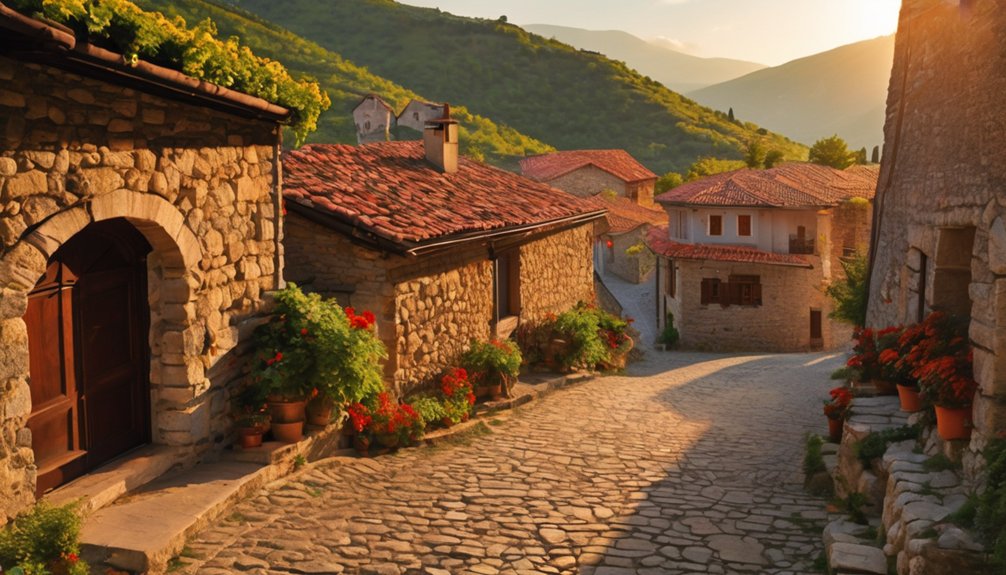
As you leave the main highway, the hills of the Western Balkans unfold. Villages appear like living time capsules. Stone houses with red-tiled roofs dot the landscape. Smoke curls from chimneys, and church bells resonate across terraced fields.
Life flows at a slower pace in these villages. Neighbors trade stories over strong coffee. Children kick a ball near centuries-old churches. Farmers return from the fields as dusk settles in.
In these authentic Balkan villages, you aren’t just a spectator. You receive warm invitations to step inside. A doorway opens, revealing a welcoming atmosphere. A table is set, and homemade rakija is poured.
These cultural experiences draw you in. You feel less like a visitor and more like family. It’s as if you’ve discovered a place where you truly belong.
How to Spot a Truly Authentic Balkan Village
How can you tell if you’re in a true Balkan village?
At first, you might feel uncertain. There’s no shiny welcome center in sight. Instead, you find a narrow lane, wood smoke, and distant voices. Working tractors pass by, and you see stacked firewood. Old men play cards, enjoying a Tuesday afternoon.
You don’t just observe; you dive into the culture. A neighbor waves you over and offers coffee. They ask about your family’s origins.
Children dart between houses while dogs snooze in doorways. Church bells chime, marking the slow passage of time.
In these genuine Balkan villages, culture isn’t staged. It unfolds naturally around you. This is the promise of authentic life in the Balkans.
Here, real experiences are still lived every day.
Top Serbian Balkan Villages for Culture & Cuisine
Step off the highway and into Serbia’s village heartlands. Here, culture and cuisine are inseparable. They weave through every stone house, orchard, and smoky kitchen.
In Zlatibor’s Sirogojno, you warm your hands over a wood-fired stove. A host offers you sir cheese and homemade rakija. Stories flow as easily as the drink.
In ethno-villages near Kovilj and Čortanovci, along the Danube, you sit at long wooden tables. You break still-warm somun bread and taste ajvar. Families proudly introduce it as “ours.”
With Balkan Tours’ driver waiting nearby, there’s no rush. You have time to linger and ask questions.
Step into gardens, watch simmering beans, and feel welcomed.
Meal by meal, you’re not just visiting Serbia. You’re experiencing its heart and soul.
Hidden-Gem Balkan Villages in Croatia, Slovenia, Bosnia & Montenegro
Serbia’s village tables linger in your memory. Yet, the road ahead unfolds new stories in the Western Balkans. With Balkan Tours’ driver waiting, you leave the highways behind. Side roads invite you into Croatia, Slovenia, Bosnia, and Montenegro. Here, dialects and woodsmoke whisper their tales.
In Grožnjan, Croatia, stone lanes beckon. Artists hang canvases from centuries-old walls. Church bells mark the slow passage of the afternoon.
Štanjel, Slovenia, offers a different charm. Karst stone houses lean into terraced gardens. Above them, silent vineyards stretch across the landscape.
Bosnia’s Lukomir greets you with steep-roofed homes. They cling to a dramatic canyon rim. The view is breathtaking, inviting exploration.
In Montenegro’s Njeguši, smokehouses dot the landscape. Old family houses frame stunning views of the Bay of Kotor. You feel less like a visitor and more like a welcomed returnee.
Hands-On Experiences
The village lane seems quiet at first glance. Yet, your day quickly fills with work-worn hands and wood smoke. The rhythm of old skills comes alive around you.
You step into a stone courtyard. A grandmother teaches you to stretch filo so thin you can see the tiled roof through it. Your fingers dust with flour as she nods in approval. You feel welcomed, folded into the household like kin.
Later, you help stack freshly split beech logs. The scent of resin clings to your sleeves. A neighbor shows you how to prune vines. He explains which grapes become family rakija and which become table wine.
As dusk falls, you sit at a long wooden table. You realize you’re no longer just watching village life. You have become part of it.
Balkan Tours: Luxury Transport
Long before you see the village roofs, luxury greets you at the curb. A Mercedes-Benz S-Class or V-Class arrives. Suddenly, the busy city fades away.
Your driver welcomes you by name and loads your bags. You settle into smooth leather seats. The quiet engine hums as Wi-Fi connects. The stunning Balkans unfold outside your window.
Highways narrow into charming village lanes, yet you remain in comfort. The climate control is set just right. Chilled water is waiting at hand.
Your chauffeur knows the best backroads to hidden stone hamlets. You’ll explore vineyard villages in Slovenia and mountain communities in Montenegro.
Along the way, he shares stories locals actually tell.
How to Plan Your Authentic Balkan Village Trip With Balkan Tours
Planning your authentic Balkan village trip begins with a conversation. It’s not about filling out a cookie-cutter form. You’ll speak with a travel specialist who listens carefully. They want to understand your desires for slower days and real kitchens.
You’ll share your travel preferences, including your companions and favorite types of silence. Whether you prefer the sea, mountains, or forests, they take note. They then match you with charming villages in Serbia, Croatia, Bosnia and Herzegovina, Montenegro, or Slovenia.
Local hosts in these villages are ready to welcome you. They know how to open doors and share stories. From there, a private itinerary is created just for you.
Your journey will include market stops and family-run konobas. You might visit vineyards along the way.
You’ll navigate village roads in the comfort of a Mercedes. This ensures you arrive as a guest, not a stranger.